From worms with squid-like tentacles to fish with teeth on their tongues, here are some of the most alien-looking creatures in the deep ocean.
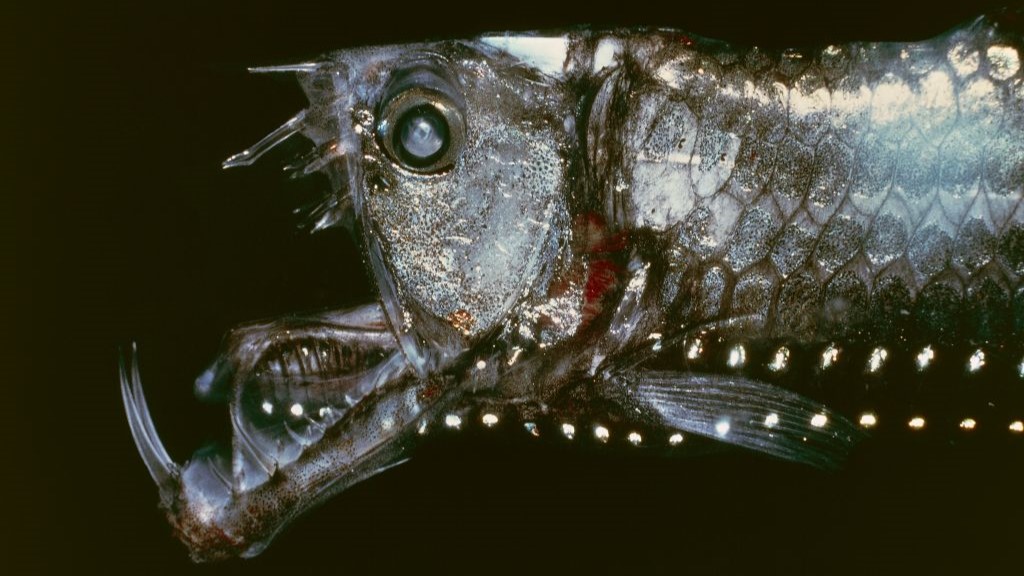
Viperfish (Chauliodus) are deep-sea weirdos with needle-sharp teeth and light-producing organs arranged all along their bodies. (Image credit: DeAgostini via Getty Images)
The deep sea is home to weird and wonderful creatures that, over millions of years, have evolved specific traits to survive the extreme conditions of their habitat. These adaptations to their environment have resulted in some truly alien-looking animals.
Scientists define the deep sea as encompassing all ocean waters below 656 feet (200 meters). In these regions, sunlight filtering through the water from above begins to dwindle, giving way to a realm of complete darkness, frigid temperatures and crushing pressure.
Some of the deepest-dwelling animals have adapted to the abyss by adopting light-producing organs to attract prey or signal to each other. Others have evolved gigantic mouths, expandable stomachs or mismatched eyes. Regardless of their specific traits, deep-sea creatures have captured the imagination of many people due to their otherworldly — and often nightmarish — appearance.
Thanks to much exploration over the past few decades, scientists have described quite a few of our deep-dwelling neighbors. So, without further ado, here are 32 of the weirdest creatures that inhabit the deep ocean.
Snipe eel

Snipe eels (family Nemichthyidae) have beak-like jaws and slender bodies. They are found at depths between 980 and 2,000 feet (300 to 600 m), although some individuals have been hauled up from 14,800 feet (4,500 m) deep. Relative to their size, snipe eels have large eyes, which the eels use to avoid predators. Their jaws are curved upward and remain open as they swim so the eels can snatch prey on their path. Snipe eels can grow up to 6.6 feet (2 m) long, depending on the species. (Nine species have been described so far.)
Frilled shark

The frilled shark (Chlamydoselachus anguineus) gets its name from the frilly appearance of its gill slits. This deep-sea shark has an elongated, eel-like body that grows up to 6.6 feet (2 m) long, as well as a large, flattened head. It is found worldwide and swims by undulating its body like a snake. The frilled shark is an active predator with several rows of needle-sharp, three-pointed teeth, which it uses to rip up its favorite meal of squid, as well as fish and other sharks. Researchers rarely encounter frilled sharks, prompting them to think the species is distributed in patches of the deep ocean.
Giant sea spider

Giant sea spiders (Colossendeis) have spindly legs that can stretch wider than a dinner plate. They live on the Arctic and Antarctic ocean floor down to depths of 13,100 feet (4,000 m), where they lumber along in search of food and mates. Like other sea spiders, they share a common ancestor with spiders and crabs but have been evolving as a separate group for hundreds of millions of years. Giant sea spiders house their vital organs, including their breathing apparatus, in their stilt-like legs. Instead of spinning a web as terrestrial spiders do, they use a long, tubelike mouthpart to slurp up prey, including anemones, worms, jellies and sponges.