Camouflage comes in all shapes and forms -Here are four other insects that look like plants.

Camouflage comes in all shapes and forms.
Scroll Down For More!

Some animals — like the snowshoe hair — change their coats from white to brown, depending on the season.

Other animals — like some bird species — sport plumage that resembles the trees and shrubs in which they reside.

And then there are some species of insects that have taken camouflage to another level. Instead of sporting fur or feather that help them blend in, their bodies have evolved to mimic the look of plants and trees.

Weather Network meteorologist Mark Robinson posted a photo of a ‘walking stick’ insect that made its way into his home.

The insect — often referred to as a ‘common walkingstick’ — is common in North America. They can grow quite large, with males reaching 75 mm for males and 95 mm for females. In Canada, you can find them in Alberta, Manitoba, Ontario, and Quebec. It is the country’s only stick insect.

Content continues below

Here are four other insects that look like plants.

ORCHID MANTIS
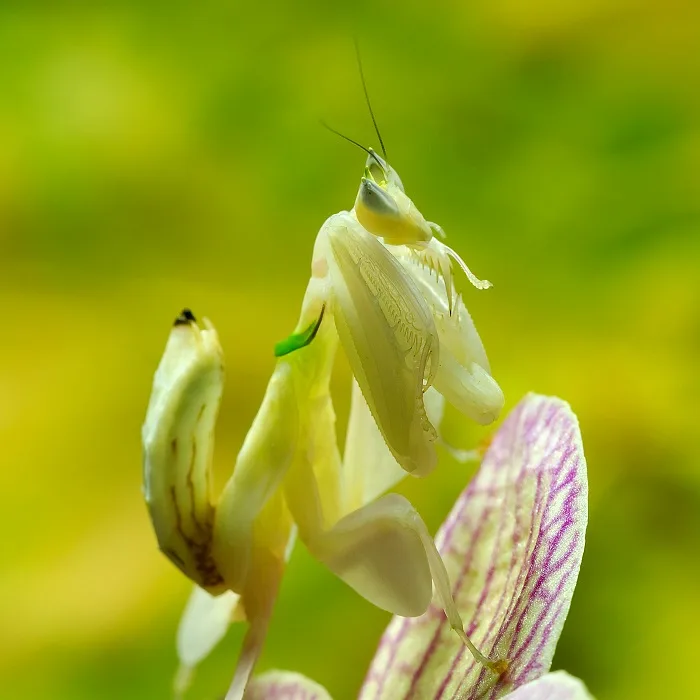
orchid mantis Wikimedia Commons Courtesy Luc Viatour -2

Blink, and you’ll miss it: This mantis is impressively disguised, with legs and marking that look like the petals of an orchid. Its camouflage is so effective scientists believe it is used to both hide from other insects and to attract prey.

In some instances, the insects are even better than actual flowers at luring in pollinators. You can find this species hanging out on orchids in tropical forests in Southeast Asia.

Photo credit

Read more

32 truly bizarre deep-sea creatures

From worms with squid-like tentacles to fish with teeth on their tongues, here are some of the most alien-looking creatures in the deep ocean.

Close-up of a metallic viperfish with its jaws wide open to reveal sharp teeth.

Viperfish (Chauliodus) are deep-sea weirdos with needle-sharp teeth and light-producing organs arranged all along their bodies. (Image credit: DeAgostini via Getty Images)

The deep sea is home to weird and wonderful creatures that, over millions of years, have evolved specific traits to survive the extreme conditions of their habitat. These adaptations to their environment have resulted in some truly alien-looking animals.

Scientists define the deep sea as encompassing all ocean waters below 656 feet (200 meters). In these regions, sunlight filtering through the water from above begins to dwindle, giving way to a realm of complete darkness, frigid temperatures and crushing pressure.


Some of the deepest-dwelling animals have adapted to the abyss by adopting light-producing organs to attract prey or signal to each other. Others have evolved gigantic mouths, expandable stomachs or mismatched eyes. Regardless of their specific traits, deep-sea creatures have captured the imagination of many people due to their otherworldly — and often nightmarish — appearance.

Thanks to much exploration over the past few decades, scientists have described quite a few of our deep-dwelling neighbors. So, without further ado, here are 32 of the weirdest creatures that inhabit the deep ocean.

Snipe eel

The profile of a snipe eel with a long, slender beak and a big eye.

(Image credit: Solvin Zankl via Alamy)

Snipe eels (family Nemichthyidae) have beak-like jaws and slender bodies. They are found at depths between 980 and 2,000 feet (300 to 600 m), although some individuals have been hauled up from 14,800 feet (4,500 m) deep. Relative to their size, snipe eels have large eyes, which the eels use to avoid predators. Their jaws are curved upward and remain open as they swim so the eels can snatch prey on their path. Snipe eels can grow up to 6.6 feet (2 m) long, depending on the species. (Nine species have been described so far.)

Read more